Poor posture can creep in during everyday life. Long hours at a desk, time on screens, slouching on the couch or repeating the same movements in sport can all influence how you hold and use your body. We may notice other people’s posture, but are less likely to recognise our own.
The good news is that posture is not only something to notice when pain starts. Being more aware of your position, moving regularly and using targeted exercises can all help you improve the way your body moves and feels. For most people, improving poor posture comes down to a combination of movement, strengthening, stretching and making small changes to everyday habits.


What is posture, and what does good posture actually mean?
Posture is the position your body naturally assumes in response to gravity. Most of the time, you are not consciously thinking about it; your muscles are working in the background to support you while you sit, stand, move and rest.
Good posture means your body parts are aligned and supported by the right amount of muscle tension. It’s not about sitting rigidly all day. How you use your body across work, exercise, rest and sleep can all influence your posture over time.
What causes poor posture?
There is rarely one single root cause; it is often a combination of factors. While you can’t change your genetics, you can change many of the habits, positions and movement patterns that affect your posture.
Common contributors include prolonged sitting, desk work, computer and phone use, slouching while relaxing, repeated movements in sport, spending too long in the same position, weak postural muscles, tight muscles, reduced mobility, and the positions you regularly use when sitting, standing or sleeping.
Forward head posture and rounded, hunched shoulders are especially common when you spend long periods at a desk or looking at a screen. Over time, some muscles may become tight or overactive while others become weak or underused.
What does poor posture do to your body?
Poor posture can contribute to muscle and ligament imbalances and may be associated with back, neck and shoulder pain, headaches, stiffness, muscle weakness and a higher risk of injury. The neck, shoulders and back are often where people notice the effects, although poor posture can affect the body differently from person to person.
Four common signs to look out for are a forward head position, rounded shoulders, frequent slouching and ongoing stiffness or tightness. You may also notice that certain positions become uncomfortable after sitting or standing for long periods.
How to fix poor posture: six exercises
Posture correction exercises can help strengthen muscles that may be weak, stretch areas that have become tight and improve mobility through the neck, shoulders and upper back. Some of the best exercises for posture target these areas while encouraging better movement and body awareness. These simple exercises can also be done at home or in the office. Be sure to stop if you feel sharp pain and seek professional advice if you’re unsure.
Chin tucks
Chin tucks target the muscles that support your neck and can help with forward head posture.
- Stand or sit tall with your back straight.
- Gently pull your chin straight back, as if you’re making a double chin.
- Keep your head level and your gaze forward.
- Hold for 5 seconds and release.
- Repeat 10–15 times.
Scapular retractions (shoulder blade squeezes)
This exercise strengthens the muscles between your shoulder blades and can help address rounded shoulders.
- Stand or sit with your arms relaxed at your sides.
- Squeeze your shoulder blades together, as if you are holding a pencil between them.
- Keep your shoulders down and away from your ears.
- Hold for 5 seconds and release.
- Repeat 10–15 times.
Chest stretch (doorway stretch)
The doorway stretch helps open the chest muscles, which can become tight after prolonged sitting.
- Stand in a doorway with your elbows bent at a 90-degree angle.
- Place your forearms on the doorframe.
- Step forward with one foot until you feel a gentle stretch in your chest.
- Hold for 30 seconds.
- Repeat 2–3 times.
Thoracic extension
Thoracic extension helps improve mobility through your upper back, an area that can become stiff when you spend a lot of time slouching.
- Sit in a chair with your hands clasped behind your head.
- Gently arch your upper back over the back of the chair.
- You should feel a stretch through your mid-back.
- Hold for 5–10 seconds and release.
- Repeat 5–10 times.
Wall angels
Wall angels combine several movements to work on posture and shoulder mobility.
- Stand with your back against a wall.
- Place your heels, buttocks and head against the wall
- Slowly slide your arms up the wall, keeping your elbows and wrists in contact with the wall as much as possible.
- Reach as high as you can without pain.
- Slowly slide your arms back down.
- Repeat 10–15 times.
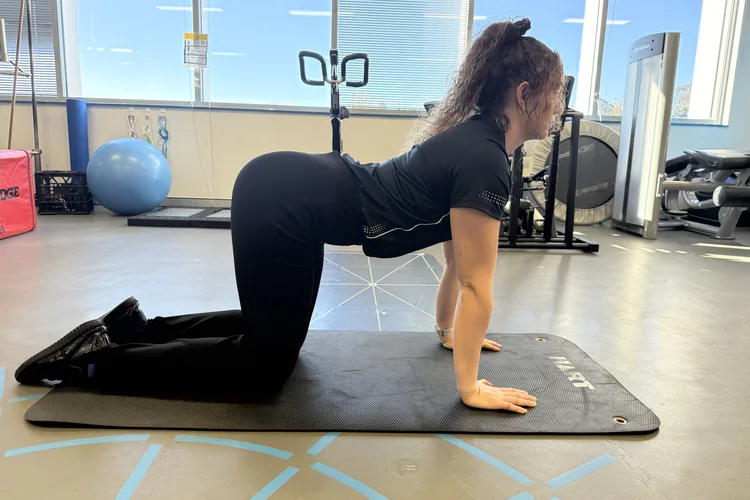
Cat-cow
Cat-cow is a gentle mobility exercise that helps move your spine through flexion and extension and can help ease stiffness through your back.
- Start on your hands and knees, with your hands under your shoulders and knees under your hips.
- Slowly round your back towards the ceiling and tuck your chin towards your chest.
- Then gently lower your stomach, lift your chest and look slightly forward.
- Move slowly between the two positions.
- Repeat 8–10 times.
How to set up your desk, chair and screen
Your workstation can make a big difference when you spend hours sitting each day. A supportive setup should help you avoid constantly reaching, hunching or dropping your head forward, while regular movement breaks help prevent you from staying in one position for too long.
Set your chair at a height that allows your feet to rest flat on the floor and position your screen around eye level. Try to sit back rather than gradually slouching towards the screen, and stand up or move every 30–60 minutes. If you regularly catch yourself slouching, use these moments as a cue to reset your position rather than trying to hold a “perfect” posture all day.
How to build the habit
Improving your posture is less about making one big change and more about building awareness throughout the day. Notice when you are slouching, leaning forward or staying in the same position for too long, and make small adjustments as you go.
Consistency is key. Along with your posture exercises, aim for 15–30 minutes of purposeful movement each day and look for simple ways to move more often. Regular walking, changing position and taking short movement breaks can all help make better posture habits feel more natural over time.
This is also why correcting years of poor posture is possible for many people. Long-standing habits may take longer to change, but they can still improve when you consistently work on strength, mobility, movement and awareness.
How long does it take to see a change?
Everyone is different, but with consistent exercises and changes to your daily habits, you may start to notice some improvement within a few weeks. More meaningful changes in strength, mobility and posture often take around 4–6 weeks.
How quickly you improve will depend on what is contributing to your posture, how long those patterns have been present and how consistently you work on your exercises, movement and daily habits. Long-standing postural habits may take longer to change, so consistency is more important than trying to correct everything at once.
When to see a physio

See a physiotherapist if poor posture is causing pain, headaches, stiffness or weakness, if you are unsure which exercises are appropriate, or you haven’t seen a change even after a period of consistent exercises. Posture can be influenced by several factors, so an individual assessment can help identify what needs attention.
A physiotherapist can assess your posture, movement, strength and mobility, look at any symptoms you are experiencing and recommend exercises or changes suited to you.
Some people may also consider chiropractic care for posture-related concerns. However, posture is influenced by factors including strength, mobility, movement patterns and everyday habits, so treatment alone may not address everything contributing to poor posture. An active plan that addresses these factors is an important part of making lasting changes.
Book a posture assessment on the Central Coast
If you want personalised help improving your posture, Coast Sport’s physiotherapists can assess what may be contributing to it and help you build an appropriate plan. With clinics in Erina and Tuggerah, you can access physiotherapy support on the Central Coast.


 Helping the Central Coast Feel Well, Move Well and Perform Well!