
Netball is a high-intensity, multi-directional sport requiring repeated accelerations, decelerations, jumps, landings, and rapid changes of direction. Whether you’re a junior athlete or an elite competitor, structured netball warm-up drills are essential for optimising performance and reducing injury risk.
At our physio and strength & conditioning clinic, we approach warm-ups with the same evidence-based principles we use in rehabilitation and performance training. A quality warm-up should:
- Gradually increase heart rate and tissue temperature
- Improve mobility and movement quality
- Activate key muscle groups
- Prime neuromuscular control for sport-specific demands
- Progress into high-speed, game-specific drills
Below is a structured guide to the best warm-up activities for netball, supported by current sports science principles.


Why Are Netball Warm-Ups So Important?
Netball warm-ups are important because they prepare the body for the sport’s high physical demands — improving sprint performance, jump mechanics, and change-of-direction control while significantly reducing the risk of lower limb injuries, particularly ACL tears. A structured warm-up is one of the most effective injury prevention tools available to netball athletes.
Research consistently shows that structured warm-ups:
- Improve sprint and jump performance
- Enhance muscle stiffness and power output
- Improve landing biomechanics
- Reduce lower limb injury risk (particularly ACL injuries)
- Enhance proprioception and change-of-direction control
Netball athletes are particularly vulnerable to knee and ankle injuries due to repeated cutting, pivoting, and landing tasks. A progressive, neuromuscular-focused warm-up is one of the most effective preventative strategies available.
Phase 1: Gradual Heart Rate Increase (3–5 Minutes)
The goal here is to elevate heart rate, increase blood flow, and raise muscle temperature without fatigue.

Examples of Netball Warm-Up Drills:
- Light jog around the court
- Forward jog → side shuffle → backpedal transitions
- Carioca/grapevine runs
- Skipping (double leg → alternating)
Coaching focus:
- Stay tall through the torso
- Controlled breathing
- Smooth, rhythmic movement
A gradual increase in temperature improves muscle elasticity and nerve conduction velocity, both of which enhance power output and reaction time.
Phase 2: Dynamic Mobility & Movement Preparation (4–6 Minutes)
Static stretching alone is not sufficient pre-game. Instead, dynamic mobility improves range of motion while maintaining power output.
Effective Warm-Up Activities for Netball:
- Walking lunges with rotation
- Lateral lunges
- Leg swings (front-to-back and side-to-side)
- World’s greatest stretch
- Ankle mobility rocks
- Deep squat prying
Why this matters:
Netball requires hip internal/external rotation, ankle dorsiflexion, and thoracic rotation. Limited mobility in these areas can increase knee load during cutting and landing.
Phase 3: Muscle Activation & Priming (4–6 Minutes)
Now we shift into activating key muscle groups for netball performance.
Key Areas to Target:
- Glute medius (lateral hip stability)
- Glute max (power production)
- Calves (force absorption and reactivity)
- Core (trunk control during pivoting and landing)
Activation Drills:
- Mini-band lateral walks
- Single-leg glute bridge holds
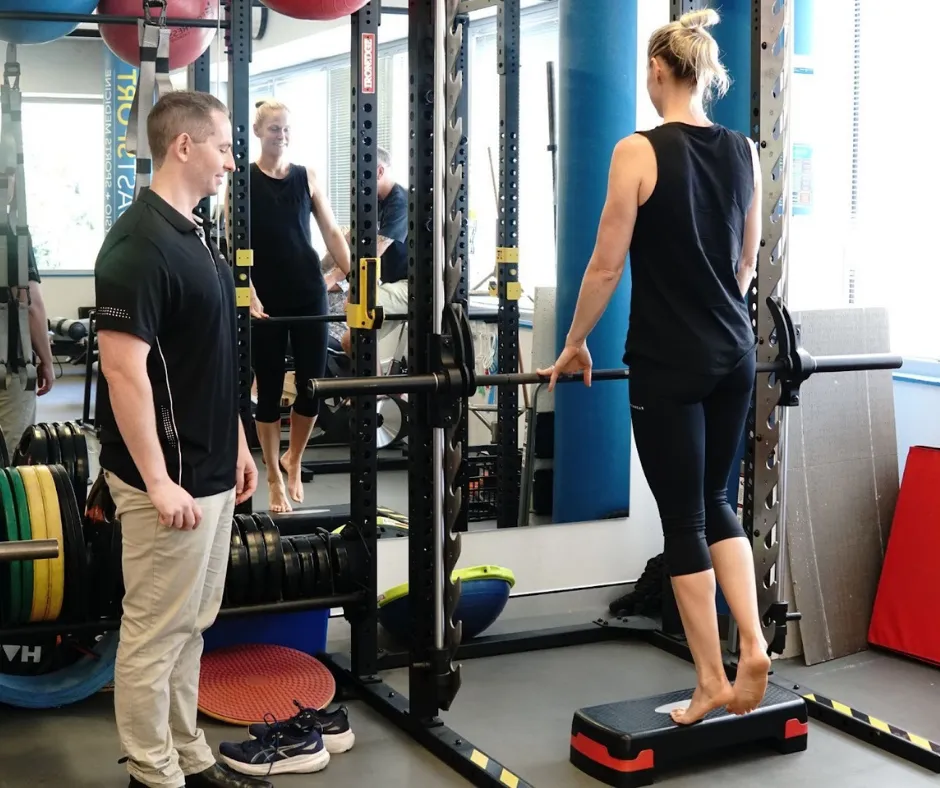
- Calf raises (double → single leg)
- Deadbugs or plank variations
- Copenhagen side plank (progressed athletes)
Evidence suggests that glute activation and trunk stability improve lower limb alignment during landing and cutting — critical in netball where non-contact ACL injuries are common.
Phase 4: Plyometric & Landing Control (3–5 Minutes)
Netball is a jump-and-land sport. Athletes must demonstrate safe landing mechanics before high-intensity play.
Recommended Netball Warm-Up Drills:
- Double-leg snap downs
- Drop jumps with stick landing
- Single-leg hop & hold
- Lateral bounds with a controlled stick
- Rebound jumps (progressive intensity)
Coaching cues:
- “Land softly”
- “Knees over toes”
- “Chest tall”
- “Absorb through hips”
Neuromuscular training programs incorporating plyometrics have been shown to significantly reduce ACL injury risk in female athletes.
Phase 5: Change of Direction & Game-Specific Drills (5–8 Minutes)
Now we prepare the athlete for netball’s reactive and positional demands.
Sport-Specific Warm-Up Activities for Netball:
- 5m acceleration → deceleration
- 45° and 90° cutting drills
- Defensive shadowing drills
- Quick feet + pivot combinations
- Pass and lead drills at increasing speed
- 3v2 transition drill (controlled intensity)
This phase bridges the gap between preparation and competition, ensuring the athlete’s nervous system is primed for speed and reactive movement.
Common Warm-Up Mistakes in Netball
Most netball warm-up mistakes come down to habit — teams run through the same routine every week without considering what the sport actually demands. The most common issues we see in the clinic are:
- Static stretching only
- No progression in intensity
- Skipping landing control drills
- Starting match-speed drills too early
- Not individualising for injury history
Warm-ups should reflect the physical demands of the sport — not just fill time before a game.
Final Thoughts
The best netball warm-up drills are structured, progressive, and specific to the demands of the sport. A proper warm-up:
- Increases performance
- Reduces injury risk
- Improves movement efficiency
- Builds confidence before competition
If you’re unsure whether your team’s warm-up is setting athletes up for success, our physiotherapy and strength & conditioning team can help design an evidence-based program tailored to your squad.
Need help implementing structured warm-up activities for netball?
Contact Coast Sport clinic to book a performance consultation or team session.
 Helping the Central Coast Feel Well, Move Well and Perform Well!