If your child has hypermobility, you may have been told they should avoid weights, sport or movements that place stress on their joints. In most cases, the opposite is true. Well-designed strength training helps children build better joint control through good technique and gradual progression. The aim isn’t to make flexible joints “less flexible”.


What does hypermobility mean in children?
Hypermobility means one or more joints move beyond the range expected for most people. It is common in children, partly because younger, developing bodies are naturally more flexible. Many children with hypermobile joints have no pain or limitations and do not need treatment.
For some children, however, extra movement is accompanied by pain, recurrent sprains, fatigue, poor balance or difficulty keeping up with sport and everyday tasks. This is when a physiotherapy assessment can help identify what is driving the symptoms.
In active kids, pain can also come from growth-related conditions such as traction apophysitis, which a physio can rule in or out. Joint flexibility alone does not diagnose Ehlers-Danlos syndrome or another connective-tissue condition.
Signs hypermobility may be affecting your child
Consider seeking advice if your child experiences:
- Regular joint or muscle pain, particularly after activity
- Frequent sprains, joint “giving way” or repeated subluxations or dislocations
- Fatigue, poor endurance or needing longer to recover than peers
- Difficulty with balance, coordination, handwriting, stairs or playground activities
- Fear of movement or withdrawing from sport because their body feels unreliable
Physiotherapists often use the Beighton score to check whether hypermobility affects many joints. It’s a nine-point test: one point for each little finger that bends back beyond 90 degrees, each thumb that can be pushed back to touch the forearm, and each elbow and knee that bends back more than 10 degrees, plus one point for placing both palms flat on the floor with the knees straight.
For children before puberty, a score of 6 or more out of 9 is considered positive. A high score on its own doesn’t mean a child needs treatment, because how their joints feel and function matters more.
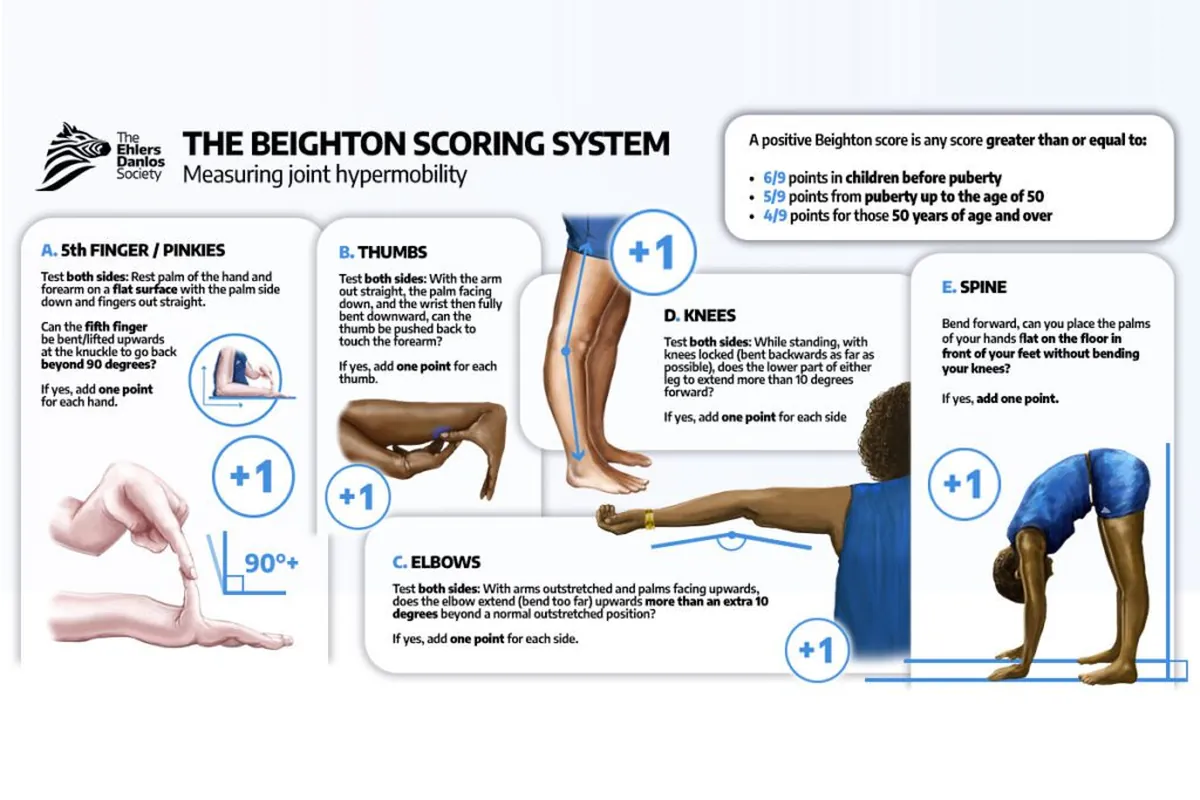
Image credit: The Ehlers-Danlos Society
Why strength training helps hypermobile joints
Muscles act like an active support system around the joints. When children improve their strength and coordination, they can become better at controlling where a joint is positioned and how it responds to load. Strength training for hypermobility may therefore improve function, reduce pain for some children and make activity feel more predictable.
An Australian trial of 26 children aged 7 to 16 with hypermobility-related knee pain found that a supervised program targeting knee strength and control reduced knee pain and improved thigh strength. A larger UK trial of 119 children also found that education, advice and positive support for healthy exercise were associated with improvements in pain, coordination and grip strength over time.
More broadly, international guidance supports well-designed resistance training for children and adolescents when it is age-appropriate, technique-focused and supervised by a suitably qualified adult. Australian movement guidelines also recommend that children aged 5–17 include muscle- and bone-strengthening activity on at least three days each week.
Potential benefits include:
- better joint control and movement confidence
- improved strength for school, play and sport
- greater balance and awareness of joint position
- gradual tolerance to running, jumping, lifting and other everyday loads
- support for bone health, general fitness and long-term activity habits
Is strength training safe for children with hypermobility?
Yes, for most children, as long as it’s supervised, age-appropriate and progressed gradually.
Strength training is not limited to lifting heavy barbells. It includes any activity in which the muscles work against resistance, such as climbing, jumping, body-weight exercises, resistance bands, medicine balls, machines and free weights. For more on how structured strength work is built, see our guide to strength and conditioning.
The key safety factors are appropriate instruction, suitable equipment, close supervision and gradual progression. The resistance should allow your child to move with control and consistent technique. Training should build their confidence rather than make them fearful of their joints.
Children with significant pain, recurrent dislocations, dizziness or fainting, or a diagnosed connective-tissue disorder may need additional assessment and a more individualised starting point.
How to start strength training safely
A good program starts with the activities your child wants or needs to do, the joints causing difficulty and their current strength, coordination and confidence. There is no single “hypermobility workout” that suits every child. The program should feel achievable and enjoyable.
What should a program include?
Programs often combine lower-limb, upper-limb and trunk exercises with balance and movement skills. Squats to a chair, step-ups, bridges, calf raises, rows, wall push-ups, carries and age-appropriate games can all be useful. Resistance might come from body weight, bands, light weights, machines or play-based tasks.
Children do not need to avoid resistance training simply because they are young. They do need age-appropriate instruction, equipment and supervision. Start with a resistance that allows calm, controlled repetitions and consistent alignment. Progress one variable at a time (for example, repetitions, resistance, range, speed or task complexity) and allow recovery between sessions.
It is also worth avoiding a rigid rule that every exercise must stop at “neutral”, meaning a straight joint rather than one bent back past straight. In the same Australian trial, children who exercised past straight had a similar drop in knee pain to those who stopped at straight, with no adverse events.
Some children initially benefit from learning control in a comfortable mid-range, while others need strength throughout more of their available range for dance, gymnastics or daily life. The safest range is individual and should be guided by symptoms, control and the demands of the child’s activities.
A simple starting point
For a child new to strength work, two short sessions on non-consecutive days each week can be a practical starting point. Choose four to six movements covering the whole body.
One to three sets of approximately six to fifteen controlled repetitions is commonly used in youth programs, but quality matters more than reaching a particular number. A five-to-ten-minute dynamic warm-up and plenty of encouragement help keep the session safe and engaging.
Here’s that starting point at a glance. Your child’s physiotherapist will adjust it to suit them.
| Part of the program | Starting point |
|---|---|
| How often | Two short sessions a week, on non-consecutive days |
| Warm-up | Five to ten minutes of dynamic movement, with plenty of encouragement |
| Exercises | Four to six movements covering the whole body, such as squats to a chair, step-ups, bridges, calf raises, rows, wall push-ups and carries |
| Sets and reps | One to three sets of about six to fifteen controlled repetitions, with quality ahead of numbers |
| Resistance | Body weight, bands, light weights, machines or play-based tasks |
| Progression | One variable at a time: repetitions, resistance, range, speed or task complexity |
| Recovery | Allow recovery between sessions |
| If symptoms build | Reduce the load, range, repetitions or complexity |
What about pain during or after exercise?
Exercise should not repeatedly cause sharp pain, a sense of instability or worsening symptoms that linger into the next day. Mild muscular effort or brief discomfort does not automatically mean harm, but the response should settle and the child should remain confident.
If symptoms build across a session, reduce the load, range, repetitions or complexity rather than pushing through poor control.
Stop and seek medical advice for a suspected dislocation, major swelling, inability to bear weight, new neurological symptoms, chest pain, fainting or pain following significant trauma. Persistent night pain, unexplained systemic symptoms or steadily worsening function also warrant medical review.
When should your child see a physiotherapist?
Book an assessment if hypermobility is causing pain, repeated sprains or dislocations, fatigue, or is stopping your child joining in sport and play.
A physiotherapist can assess more than flexibility. They can look at strength, balance, movement patterns, pain, fatigue, previous injuries and the demands of your child’s sport or daily routine.
From there, they can create a graded plan, liaise with school or coaches when needed and help your child distinguish normal training effort from a warning sign.
The goal is not to make a child fearful of their body or to remove activities they enjoy. It is to help them build the capacity to participate with fewer setbacks. If hypermobility or hypermobile joints are affecting your child’s comfort, confidence or activity, our Central Coast physiotherapists can help develop a safe, individualised strength-training plan. Book an appointment.
References:
- Tofts LJ, Simmonds J, Schwartz SB, et al. Pediatric joint hypermobility: a diagnostic framework and narrative review. Orphanet Journal of Rare Diseases. 2023;18:104. doi:10.1186/s13023-023-02717-2
- Pacey V, Tofts L, Adams RD, Munns CF, Nicholson LL. Exercise in children with joint hypermobility syndrome and knee pain: a randomised controlled trial comparing exercise into hypermobile versus neutral knee extension. Pediatric Rheumatology. 2013;11:30. doi:10.1186/1546-0096-11-30
- Bale P, Easton V, Bacon H, et al. The effectiveness of a multidisciplinary intervention strategy for the treatment of symptomatic joint hypermobility in childhood: the Bendy Study. Pediatric Rheumatology. 2019;17:2. doi:10.1186/s12969-018-0298-x
- Lloyd RS, Faigenbaum AD, Stone MH, et al. Position statement on youth resistance training: the 2014 International Consensus. British Journal of Sports Medicine. 2014;48(7):498–505. doi:10.1136/bjsports-2013-092952
- Australian Government Department of Health, Disability and Ageing. Recommendations for children and young people (5 to 17 years). Updated 13 March 2026. View the Australian physical activity guidelines

 Helping the Central Coast Feel Well, Move Well and Perform Well!